AI must become more human
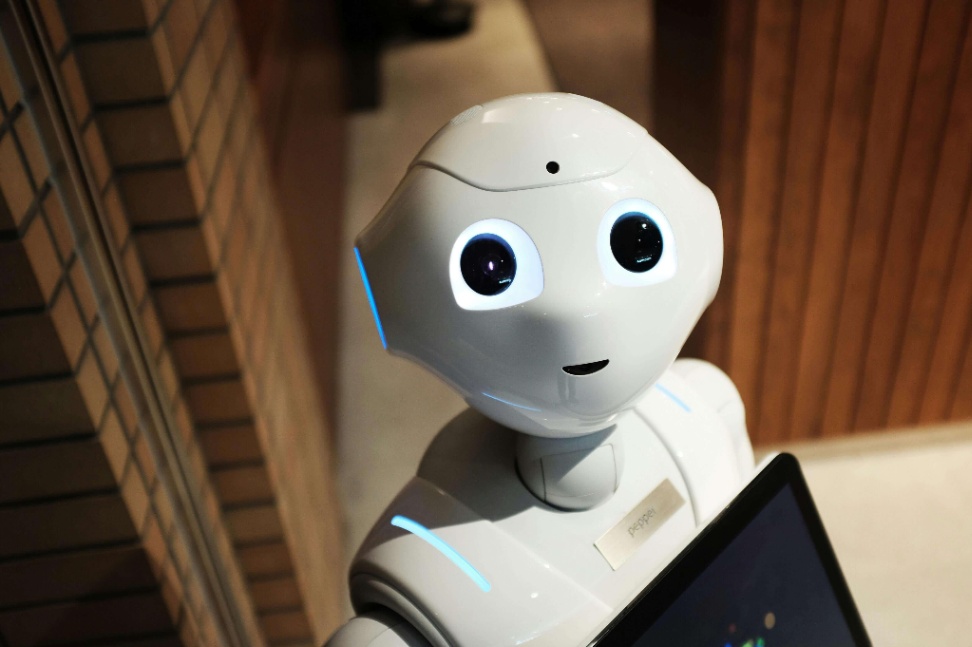
In future, we will work with AI as we do with humans. Ideally, the capabilities of humans and AI will complement each other to create something new. For this to succeed, AI must become more human. Text: Thomas Gull
In Anand van Zelderen's laboratory, the future of work has already begun. Johanna and Johan sit at the same office desk as flesh-and-blood humans and cheerfully join in the work. They are AI avatars that look like humans and, at least to some extent, react like them too. ‘When you talk to Johanna, she responds, but it takes her two to three seconds,’ explains management researcher van Zelderen from the Institute of Business Administration. He believes that many of us will be working with such AI avatars in the future and has therefore tested how we react to employees with artificial intelligence. The result: if they have human traits, we are more likely to appreciate them than we would a robot or traditional generative AI such as ChatGPT.
Integrative and open virtual worlds
The more human AI looks and behaves, the easier it is for us to cooperate with and trust it. ‘To successfully integrate AI into everyday working life, we need to create virtual working environments in which people can interact with AI as naturally as possible,’ concludes van Zelderen. He therefore founded the Openverse Initiative, which aims to create inclusive, open and ethically responsible virtual worlds and now comprises 25 academic institutions worldwide. ‘Virtual environments, such as those we are designing with Openverse, can completely change the way we work,’ says van Zelderen. The technological revolution brought about by AI means that even cognitive human work can be done by computer programmes.
However, it remains unclear which human activities AI can replace. ‘In the past, new technologies have taken on tasks that were well structured and clearly defined,’ says computer science professor Abraham Bernstein. ‘The question is whether AI can also perform more complex tasks.’ In his view, this is not yet the case. ‘Today, human collaboration with generative AI such as ChatGPT is more like a tedious ping-pong game of questions and answers.’ The AI algorithm remains a black box with unknown functionality – and sometimes incorrect answers. The challenge for users is to recognise these, because even incorrect answers can be formulated convincingly.
The use of AI in the workplace therefore depends heavily on how reliable the programmes are. And: ‘We still need to be able to judge whether the results delivered by AI are any good. That's why we will continue to have to learn things that we will never use, because machines can do them better and faster, such as mental arithmetic today,’ says Bernstein. Although the calculator does the maths for us, we still need basic mathematical skills to be able to estimate the magnitude of numbers.
We can think better
One of the dystopian visions associated with AI is that it will largely render human labour superfluous. Bernstein considers this to be a rather unrealistic scenario. Professions consist of a bundle of activities – some of which could be taken over by AI, others not. ‘We will be able to hand over certain tasks to machines and concentrate on others,’ he predicts. Human intelligence will still be needed in the future. This is because humans can think even better than AI because we can combine reactive and reflexive thinking, explains Bernstein. Reactive means reacting quickly and immediately to situations, while reflexive refers to the ability to critically question one's own results.
The latter is (still) difficult for AI. The advent of AI in the world of work therefore does not mean that human labour will become obsolete, but rather, according to Bernstein, that ‘humans and AI must find the right relationship’. It requires a combination of the strengths of both sides: the infinite endurance and computing power of machines and the analytical thinking, knowledge and intuition of humans.
Don't get too comfortable
That sounds promising. However, based on his study with avatars, Van Zelderen warns of the negative effects of working with AI: ‘We have to be careful not to become too dependent.’ As his study shows, people are less engaged when they work with AI and are less satisfied with their work. Van Zelderen also believes that spending the whole day in a virtual working environment is unhealthy. ‘The ideal is a mixture of reality and virtual elements.’
The big challenge is to design collaboration with AI in such a way that people feel comfortable. Van Zelderen is convinced that AI must become more human, for example by giving it a human face and making it behave in a human-like manner. At the same time, research should view generative AI not only as a tool, but as a co-worker, because the interactions between employees and AI are similar in many ways to those with real people. ‘If we succeed in creating harmonious collaboration between AI and humans, the new technologies will support human potential rather than undermine it.’
Abbreviated version, source: Oec. Magazine #22; full article in UZH Magazine 3/2024
Abraham Bernstein is Professor of Dynamic and Distributed Information Systems at the Department of Computer Science UZH and Director of the Digital Society Initiative. Anand van Zelderen is a post-doctoral research associate at the Department of Business Administration UZH.