Why We Often Approach Conflicts in the Wrong Way
Constructive conflict resolution is not a matter of talent, but of understanding and practice.
Article by Prof. Dr. Jan Schmutz

The Tagesanzeiger reports: “We’d rather call in sick than tell our boss what’s bothering us.” Nearly 60 percent of all absences due to illness are attributed to conflicts (Tagesanzeiger). The problem isn't that we have conflicts, but how we deal with them.
Many people hesitate to address conflicts early on. We’re afraid that things will escalate, that there will be negative consequences, or that we’ll be overwhelmed by our own emotions. Instead of seeking a conversation, we often avoid it until the situation becomes more difficult.
One reason for this is that we often approach conflicts intuitively, but not particularly helpfully. We believe we’re talking about facts, make assumptions about intentions, or look for someone to blame. These cognitive biases quickly lead to misunderstandings, defensiveness, and escalation.
The good news is: Constructive conflict discussions aren’t a matter of talent, but of understanding and practice.
You can think of conflicts like a mountain. At first glance, it seems intimidating, and many hesitate to even attempt it. However, when we climb a mountain, we don’t just set off. We first get an overview, examine possible routes, and prepare ourselves.
It’s similar with conflicts. Instead of reacting spontaneously, it helps to pause, understand the dynamics, and enter the conversation with intention.
Why do we see the same situation in completely different ways?
In many conflicts, people assume there is an objective truth about what happened. In reality, however, we often experience the same situation in very different ways. We have different information, pay attention to different details, and interpret events differently.
Here’s a small example from everyday life: I took my 4-year-old daughter to the Sechseläuten children’s parade. That evening, we talked about it, and it was as if we’d been to two different parades. I mostly remembered the big parade floats, while she could tell me exactly which candies were handed out.
What we perceive and how we make sense of it is strongly shaped by our experiences, expectations, and interests. This results in different “stories” about what happened.
You can think of this process as a “ladder of conclusions”: We observe a situation, interpret it, and draw conclusions from it.
-
Observation: The report was sent on Friday at 6:30 p.m. (the deadline was 12:00 p.m.)
-
Interpretation: “The report was late”
-
Conclusion: “That person is unreliable”
The problem is: We often think we’re talking about facts, even though we’ve long since moved into the realm of interpretations or judgments. This is precisely where many misunderstandings arise.
A key goal in conflict discussions is therefore to take a step back to the level of observation and make the different interpretations visible.
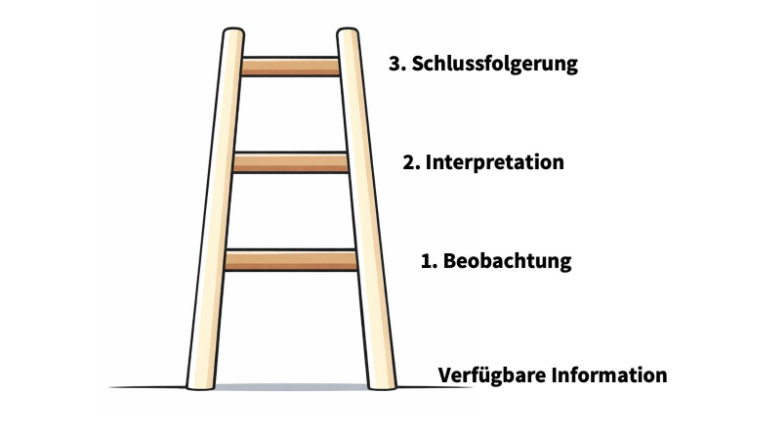
(Image only available in German)
Three cognitive biases that cause conflicts to escalate
When we approach conflicts unprepared, we often fall into typical cognitive biases. They usually happen automatically, and that is precisely why they are so effective.
1. The Assumption of Truth
We tend to believe that our perspective reflects objective reality. No one enters a conversation thinking, “Maybe I’m wrong.” Instead, we assume that we know the relevant facts and are assessing the situation correctly.
When the other person has a different perspective, it quickly seems like a mistake or a distortion. In reality, however, both sides are usually not talking about facts, but about their respective interpretations.
2. Attributing Intentions
We often think we know why someone behaves a certain way. Especially in conflicts, we are quick to assume negative motives: the other person wanted to criticize us, hurt us, or show off.
The problem is that we generally do not know other people’s actual intentions. At the same time, we often judge our own behavior more favorably and explain it away with circumstances like stress or time pressure.
This bias leads us to interpret behavior too quickly as a character trait (“That person is unreliable”) instead of examining the situation more closely. Negative assumptions about intent quickly trigger defensiveness in the other person and prevent an open conversation.
3. The Focus on Blame
In many conflicts, attention is focused on who is responsible and who made the mistake. However, this search for blame rarely leads to a better understanding. Instead, it intensifies accusations and defensiveness.
A more helpful perspective is to shift the focus from blame to contributions. In almost every conflict, both sides have contributed to the situation, even if their own part seems small. The crucial question is not, “Who is to blame?” but rather, “What did each side do that contributed to the situation developing this way?”
These three cognitive biases cause conversations to quickly stall or escalate. Recognizing them lays the foundation for dealing with conflicts constructively.
What can we do?
We encounter these cognitive biases all the time in our daily lives. They become even more likely when we’re under stress or time pressure. The problem is that they quickly steer conversations in a direction marked by defensiveness, justification, and mutual recriminations.
An important first step is to consciously shift the conversation—away from the question of who is right, and toward the question of how the situation was experienced by both sides. The goal is not to find a “correct” version, but to develop a better shared understanding. Often, this means taking a step back down the ladder, away from interpretations and back to what we actually observed.
A helpful strategy is to frame your own viewpoint as a perspective rather than an objective truth. This signals openness and reduces the likelihood that the other person will become defensive.
For example:
“I received the report at 5:30 p.m. We had set the deadline for 12:00 p.m. This put me under quite a bit of time pressure. I’d be interested to hear how you think this came about.”
It’s equally important to distinguish between effect and intention. We often experience others’ behavior first through its effect on us and immediately infer an intention from it. It’s more constructive to describe the effect and leave the intention open.
For example:
“When the presentation was changed at the last minute, I was a little confused because I had prepared for the original version. I’m not sure what the reason was. Can you explain to me how this happened?”
Another key change involves shifting the focus from blame to contributions. Instead of determining who is responsible, we work together to examine how various factors contributed to the situation. This creates space for learning and collaborative solutions.
For example:
“When I think about it, I probably should have mentioned earlier that the report was urgent. At the same time, it may not have been entirely clear who was supposed to send the final version. Perhaps we can work together to figure out how to clarify this in the future.”
Finally, it can be helpful to actively broaden your own perspective. A simple exercise is to ask yourself how the other person would describe the situation or how an uninvolved third party would view it.
This kind of shift in perspective helps put your own assumptions into perspective and identify blind spots. The goal is not to abandon your own viewpoint, but to supplement it with additional perspectives.
Why Emotions Can Be Crucial in Conflicts
Conflicts are rarely purely factual. Even when we think we’re discussing facts, emotions almost always play a central role. Anger, frustration, disappointment, or uncertainty influence how we listen, how we interpret things, and how we react.
The problem is that emotions are often not addressed openly. Instead, they manifest indirectly, for example through a sharper tone, withdrawal, or sarcastic remarks. As a result, they escalate the conflict without making it clear what is actually behind it.
At the same time, it’s true that we rarely have good conversations during highly emotional moments. Under stress, we react more quickly, listen less attentively, and are more likely to go on the offensive or defensive. It can therefore be wise to postpone a conversation when your own emotions are running high.
A constructive way to deal with emotions is to acknowledge them, name them, and connect them to a specific concern. Feelings often indicate that something is important or that expectations have been unmet.
For example:
“To be honest, I was pretty frustrated when I saw that the report wasn’t finished yet.”
Or:
“I felt a bit overlooked during the meeting. It’s important to me that I’m able to voice my points.”
It’s just as important to recognize and acknowledge the other person’s emotions. People are more willing to listen when they feel understood.
Emotions are therefore not a disruptive factor in conflicts, but an important source of information. When expressed constructively, they can deepen understanding and steer conversations in a more productive direction.
Conflicts are no walk in the park
Effective conflict resolution doesn’t come from being right, but from understanding. Those who are willing to question their own perspective will not only have better conversations but also build stronger relationships.
Just like in mountain climbing, conflict isn’t about rushing headlong into it, but about proceeding with awareness. Those who prepare, understand the dynamics, and choose a clear path increase their chances of reaching the summit without the situation escalating.
Referenzen
Stone, D., Patton, B., & Heen, S. (2010). Difficult conversations: How to discuss what matters most (2nd ed.). Penguin Books.
Stone, D., & Heen, S. (2014). Thanks for the feedback: The science and art of receiving feedback well. Viking.
Interessieren Sie sich für Konfliktmanagement?
The Konfliktmanagement module (which counts toward the DAS in Business Management, CAS in Leadership, and CAS in General Management programs) enables participants to view conflicts not as a threat, but as an opportunity for growth. The module’s goal is to reduce hesitation when it comes to difficult conversations and to build confidence in handling conflict situations. Through a practical combination of theoretical input, interactive exercises, and realistic role-plays with professional actors, participants learn to analyze conflicts. They also develop effective strategies to identify conflicts early on, address them constructively, and resolve them in a solution-oriented manner.