From Head to Heart - Shaping the Future of Work
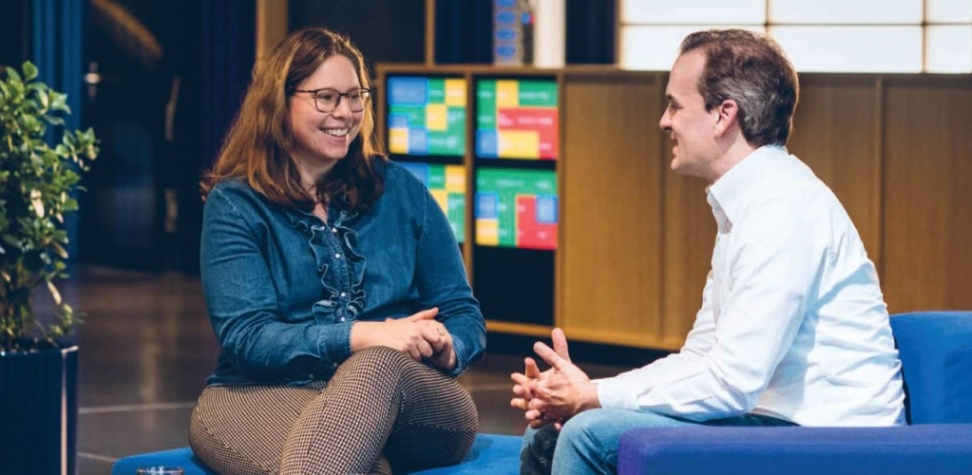
When we talk about the future of work, we mainly focus on new technologies and tech-related skills. Prof. Jochen Menges from the University of Zurich and Elodie Lhuillier from Google Switzerland discuss why we should keep an eye on people, as well. Text: Tania Weinfurtner, Photo: Caroline Krajcir
Both of you are strongly engaged in shaping the "future of work". What does it actually mean?
ELODIE LHUILLIER (EL): For us at Google, the future of work describes a change of work paradigms, influenced by technological, generational, and social shifts.
JOCHEN MENGES (JM): On the research side, we think that the future of work actually happens twice: Once today, in our heads – how we think it will happen and how we prepare. And then in reality – how these changes will actually play out.
So, how will the world of work change in the future?
JM: There is a clear shift in how work has developed: from our hands to our heads to our hearts. That’s what the future of work will be about: What we as people do with our hearts when machines do what we used to do with our heads and hands.
EL: By recentering on the heart, we move from a process-centered to a more human-centered approach to work, supported by technology.
Do these findings feed into research on the future of work?
JM: There is a heavy focus on the technological developments and on macro policy questions. What’s been neglected is the question about the future of work in the here and now: What’s happening in people’s heads and how that relates to how they feel and what they do about the future of work. That’s the unique angle that we take at UZH.
Does this research have an impact on the practice of HR?
EL: Yes, I think research insights come through in all industries and companies as they have to adapt to attract and keep talent. At Google, we base most of our people practices and processes on data and research. We stay very tuned to what’s happening in research and academia, and we have an internal People Innovation Lab that researches people topics.
Google invests a lot in people innovation. What is the benefit?
JM: People innovation brings the scientific mindset to HR, a practice that is largely experience-based – you do what you think has worked. We want to create an HR practice that is evidence-based. That’s where a lot of innovation is going to happen in the future so that we can better understand how people can be their best at work, both from a wellbeing and a productivity side.
EL: People spend such a large part of their lives at work; that work should be an experience that contributes to their happiness, fulfillment, and health. That’s why we believe that a human-centered approach is key, and that research and innovation can help us address the challenges.
So, in a nutshell: What skills will be needed in the job market of the future?
EL: With increasing automation, the focus will be more and more on those skills that are unique to humans, revolving around emotional intelligence, resilience, the ability to strive for self-improvement.
JM: We need STEMpathy – coined by Thomas Friedman in a New York Times article – i.e. both technical and socioemotional skills. How we combine both types of skills will determine the success of people in the future.
What should companies do to foster emotional intelligence?
EL: Fundamentally, it’s about care and respect. Giving people a voice, listening to them, leaving room for emotions. By exposing ourselves more to emotions in a professional context, we will all become a little bit more fluent and increase our collective emotional intelligence.
JM: On the one hand, companies need to focus on emotional intelligence as an individual skill set that employees should have and be able to grow at work. On the other hand, and this is often lacking, companies should build a culture that encourages employees to use and show their emotional intelligence at work and that rewards employees for doing so. We thus need companies to develop into what I call «emotionally intelligent organizations».
Some people might be skeptical when they hear about emotional intelligence. Why should they nevertheless invest in developing those skills?
JM: Because it benefits them. If we’re better able to deal with emotions so that they can help us reach our goals, we are just better off : our well-being and happiness increase, and we’re better colleagues. Beyond that, evidence tends to show that emotional intelligence relates to job performance, creativity, sick days – to many of the things that matter in businesses and that turn into what we often call the hard results.
EL: Yes, absolutely. I see emotional intelligence as a foundation. Once you have this capability, you have the ability to recognize when you need to adapt or change.
How will this change the way we lead in the future?
EL: Apart from getting things done, the developmental and emotional aspect of management will be important. A good manager needs to create an inclusive, trusting team environment and show concern for the success and well-being of the team and its members.
JM: When it comes to leadership, two things matter: a concern for people and a concern for results. It’s really important that these dimensions work together instead of prioritizing one over the other.
A big change in our daily work life happened just recently due to the pandemic. What impact has it had regarding the future of work?
EL: It accelerated the change and forced pretty much every industry to think about what the future of work will look like.
JM: It also shifted attention towards the people-centered approach. On the one hand, technology allowed us to remain productive despite social distancing. On the other hand, it became clear that technology still leaves a lot of human needs unfulfilled.
After almost two years of people working mainly remotely, will there still be a need for physical office sites in the future?
EL: Well, we’ll need a refresh after the pandemic. The first thing will be to focus on why employees need to be in the office. A lot of data indicates that the future of the office will be one of interaction and collaboration above all. The other challenge will be to optimize hybrid types of work, to ensure that every employee can participate in a meeting, no matter where he or she works.
JM: The shift in work design from functional entities to socioemotional spaces will make the office of the future very different. Spaces are now more thought of as environments that spark emotions to facilitate work. In a next step, we will also have to think about how to get that same kind of experience in the virtual format and ultimately how to blend the two.
So, in summary: How can companies prepare for the future of work?
JM: I’d say, join the HR Valley, the people innovation ecosystem that we’re currently developing in Zurich . It will bring businesses, academia, and others together to co-create the future by jointly working on it. Let’s bundle up and address this issue together – it’s too big for any company to solve alone.
EL: Listening to your employees is crucial: giving them a voice and hearing what’s working, what’s not. Thus, an individual company will learn but also benefit from other companies’ experiences through an open exchange about the challenges and how to tackle them.
And what can we do in our own lives to create our version of the future?
EL: As an individual, I try to be comfortable with my emotions: being able to talk about them and handling them in a productive fashion. And as a mother, I’m trying to help my kids learn to embrace and deal with their emotions from a young age on so that they are able to interact with others in an emotionally intelligent way.
JM: The future is ours to create. We can all shape it, rather than simply await it, through the choices we make every day. Choices that relate to how we inform ourselves, critically think about and ultimately prepare for the future; how we endorse and invest into skillsets and values; and how we relate to, work with and lead others. When my children grow up, I hope that they will find themselves in a world of work that will have embraced the principles of emotional intelligence and that will enable everyone to do what we are best at as people: be human.
(Professor Jochen Menges holds the Chair of Human Resource Management and Leadership and serves as the Director of the Center for Leadership in the Future of Work at the University of Zurich. In his research, he focuses on the social dynamics between leaders and followers, and on the role of emotions and motivation in organizational life.
As Head of HR for Switzerland, Elodie Lhuillier is responsible for Google‘s HR strategy in Switzerland, with a strong focus on culture, diversity and dealing with unique people challenges locally. The Zurich office is Google‘s largest research and development site outside of the USA and employs over 4500 people of more than 85 nationalities.)
Text: Tania Weinfurtner, Photo: Caroline Krajcir
Source: Oec. Magazine issue #16