Prof. Alexander Wagner, Chairman of Executive Education
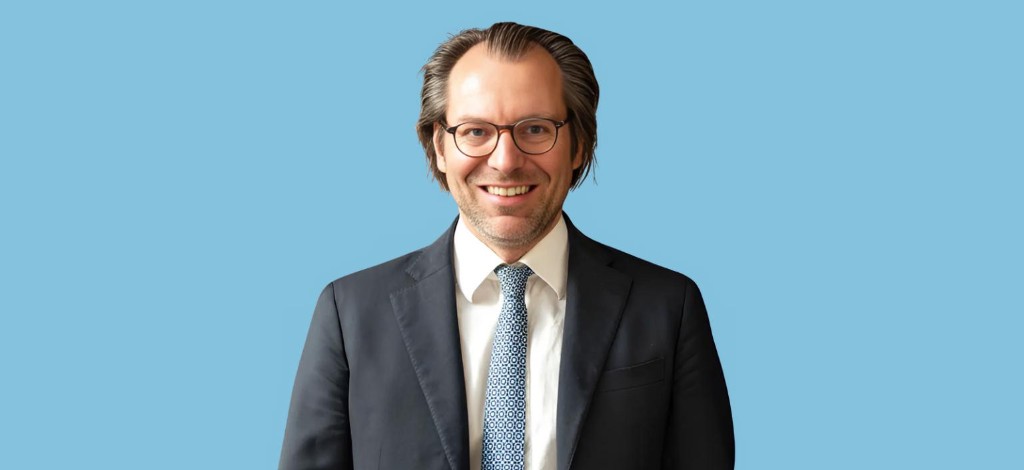
“Discovery, teaching, and doing are a dream team. And they never get boring.” That is the credo of Prof. Dr Alexander F. Wagner, Vice Dean of Continuing Education and Chairman of Executive Education. He teaches as a professor of finance at the University of Zurich and is Swiss Finance Institute Senior Chair. He also played a key role in founding Executive Education and served as its CEO in its early years. How does he assess the development of Executive Education to date, and what impact does he see current trends such as artificial intelligence having on the continuing education landscape and his own teaching activities?
Your daily work combines two passions: the enjoyment of researching the fundamentals of human behaviour for the sake of knowledge, and the desire to apply these findings in the real world to improve the functioning of markets and organisations. How do you apply the insights you have gained to the University of Zurich and Executive Education (ExecEd)?
In many ways. On the one hand, insights from behavioural science are also relevant for positioning ExecEd's offerings. On the other hand, my work for ExecEd and UZH also inspires me for future research on how organisations function.
Four years ago, you spearheaded the establishment of Executive Education at the Faculty of Economics. What was your motivation behind this, and what role did you play in its creation?
Continuing education has a long, positive history at our faculty. The idea of bringing all programmes under one roof was motivated by a desire to strengthen our external image, to foster greater innovation internally through opportunities for exchange between programmes, and to achieve a certain degree of harmonisation in our strategic direction. I had already been active in steering committees and teaching continuing education courses for a long time, so I was also involved in the founding of ExecEd. The faculty then elected me, as Vice Dean of Continuing Education and Alumni, to head the entire unit. It was and still is very important to me to maintain a good balance between a common direction (‘top-down’) and individual initiative (‘bottom-up’).
The purpose statement of Executive Education is: ‘To share with the intellectually hungry the freedom and joy we gain from critical and courageous thinking so that we empower them to more creatively and purposefully shape the economy and society of today and tomorrow.’ How do you support this purpose in your various roles at ExecEd?
I still find this purpose beautiful; it is the basis of our differentiation. In times like these, it is particularly important to emphasise freedom and courageous thinking, as we do in our purpose. I experience this purpose most directly when teaching. I believe (and always say) that continuing education should be fun, both for participants and lecturers. This purpose forms the basis of our Vision 2030 and our specific strategies and goals.
Executive Education's Vision 2030 is based on three pillars: ‘Connect: Anchored in the heart of Europe,’ ‘Inspire: Inspired by diversity,’ and ‘Empower: A pioneering spirit in action.’ What does this vision mean for Executive Education, its staff and students?
The vision does not describe the current situation, but rather an aspiration, a direction. It therefore sets out expectations, including for ourselves. A few examples: The first part emphasises that we do not work in a ‘bubble’ but actively strive to expand our sphere of influence. The second part calls on us and our students to understand diversity as a strength. That is easy to say, but putting it into practice requires a special level of commitment. The third part is similar: yes, everyone wants to see themselves as innovative and forward-looking. But the challenge here is to actually do it, so that the pioneering spirit is truly lived and felt. When we reach 2030, I hope that we will look back on 2025 and say, yes, we have come a long way since then.
How do you support Executive Education in implementing this vision?
Now, as chairman, my primary role is to ensure that we maintain our fundamental direction and are not distracted by the noise that naturally occurs from time to time. I try to find as many interested professors as possible within the faculty. Through my interdisciplinary research activities, I am also in contact with research in other faculties, which helps us to enrich our offerings. I also have the advantage of not being too involved in day-to-day business, which means I can regularly bring up larger issues.
You were CEO from the founding of ExecEd until Jürgen Brücker took over the position. What projects did you focus on at that time?
As CEO, I worked with the management team to develop the first strategy for 2021–2024, with specific goals in four areas: customers instead of products, content excellence, external excellence, and internal excellence. The first point was particularly important to me: to fulfil our purpose, we need to know what is happening in the world around us and take an interest in it. The development of our purpose and the core elements of our joint presence also took place during this period. In addition, of course, there were many things that you don't see or that you would only see if they didn't work. Overall, even though the goals seemed quite ambitious at the time, I am happy to say today that we have achieved them.
Which milestones in executive education are you particularly proud of?
In the first four years, we reached approximately 800 participants each year. All this in a challenging market environment: COVID-19 and the Russia-Ukraine war increased uncertainty and reduced the willingness of people and companies to invest in further education. We developed a purpose, a vision, a strategy, a common identity, hired a CEO, established a shared workplace for all ExecEd employees, launched new programmes tailored to current needs, and celebrated important successes with custom programmes, i.e. programmes specially tailored to individual customers. But I also say: we still have a lot of potential, and I am aware that not everything always runs smoothly. That's why the motto is: keep at it. You ain't seen nothing yet.
How is executive education positioned in the continuing education landscape (nationally, internationally)?
Overall, we position ourselves as a provider of lifelong learning. Depending on the subject, we operate locally or internationally. Programmes on real estate and finance, for example, tend to be locally oriented, while general management programmes are also intended to have international appeal. In future, the central element of our positioning should be the diversity of content at UZH. We are not a typical business school, but cover a much broader range of topics. However, this is not a sure-fire success, but must be translated into concrete, usable offerings.
How can AI be used effectively in continuing education and teaching?
AI offers many opportunities to implement our purpose, vision and strategy even more effectively. One example: in our finance courses, we have been experimenting for some time with chatbots that have been specifically trained on our materials. We also plan to launch AI-generated introductory videos featuring the voice and gestures of a lecturer. This will leave more time for personal interaction on more advanced topics. AI can also assist as a co-teacher in the classroom itself. I see exciting opportunities here, particularly in my field of corporate finance.
Your current research focuses on sustainable finance, crisis competence and behavioural economics. How can your research findings be translated into teaching in continuing education?
Certain topics are simply fundamental. The basics of financial management and corporate finance, for example, are relevant everywhere – if only to better understand what is written in the newspaper. The basic concepts do not change very quickly, but of course the financial market always has surprises in store, so I include something new from current events in almost every lesson. In continuing education, it is naturally easier for lecturers to build on the participants' own experiences than in undergraduate studies. With almost 20 years of experience, I think I have a certain sense of how to meet participants where they are, while also helping them to question certain practices they are used to, thereby providing them with moments of insight. The topic of sustainability has also been a focus of my research for a long time – much longer than it has been en vogue – and this also allows me to continually contribute new insights to continuing education, most recently, for example, on the topic of biodiversity and entrepreneurial activities.
How do you find a balance with your demanding job?
I am fortunate to have a job that matches my calling. For me, the balance between research, teaching and management is fulfilling. Of course, I also need some distance from time to time. Family is the absolute priority anyway. And family life also helps me not to take everything – and especially myself – too seriously and too importantly. We tell our children: Daddy is going to the university to play.