A portrait: Beat Hedinger, from boy scout to military pilot
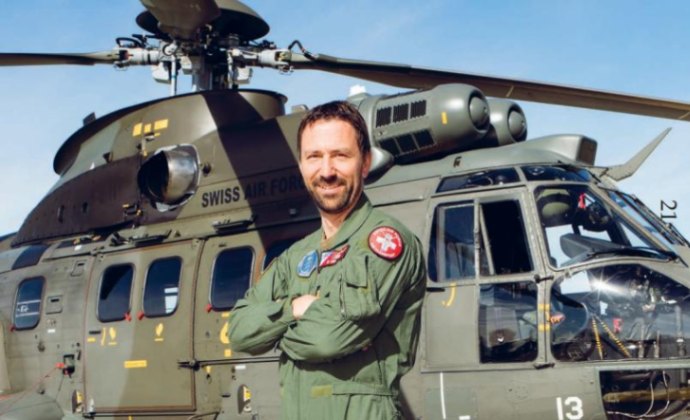
Alumnus Beat Hedinger is living his dream. He is a military pilot, promotes young talent at SPHAIR and wrote his dissertation during foreign missions in the Balkans. Text: Graziella Bomio, Photo: Peter Hauser
A provocative question to start with: Why does Switzerland need professional military pilots?
We professional military pilots defend Switzerland and form an important complement to the existing services of the police and Rega. For example, we provide helicopter standby services for the search for persons, disaster relief and search and rescue. In the case of forest fires, for example, civil helicopters are used first, but they can only carry 500 liters of water per drop - ours 2.5 tons. Or on a search mission, the Rega helicopter pulls out after an hour at the latest - after that, we take over. Thanks to our infrared equipment, we can also fly such missions at night. With the professional military pilots, the state has a strategic reserve for such missions, because it would not be economical to operate them in civilian mode. If we want to provide a safe country, we have to invest. This has become clear since the conflict in Ukraine.
Originally, you completed a completely different education. You studied business administration. Why is that?
I always wanted to be a scout leader when I was a kid. I wanted to organize, optimize, hold together, move forward. So studying economics was an obvious choice, especially management and economics, which combines the best aspects of economics and business studies. How much of what you learned can you still apply today? A great deal. In particular, as head of SPHAIR and commander of helicopter training for the Air Force, I have to think very analytically and holistically, which I learned in economics lectures. From business administration, I use accounting and marketing - and also scientific work when I create a concept or launch a project.
So would you make the same study choice again today?
Absolutely, and psychology as a second degree. I was particularly interested in the interdisciplinary aspects. I wrote my dissertation at the interface between psychology and economics. This area is also very important in my work, because we work with people and not with machines or large corporations.
As a military pilot, you were also stationed abroad several times. What did you experience there?
My highlight was in Greece in 2015: I was able to save a village from the flames. There is nothing more fulfilling than that. Everything I had learned and done so far was worthwhile. It was also very impressive to see the destroyed villages in Bosnia from the helicopter. Those images really get under your skin. It's different from seeing them on TV or in the newspaper. And you know exactly what needs to be prevented.
As an instructor, you work primarily with junior pilots. What is so special about it?
I get to share my passion. At the beginning of a SPHAIR course I have girls and boys, at the end they are young adults. They learn so much independence and self-confidence: When a young person sits at the controls of an airplane, eyes shining, making their own decisions, it's priceless. The best thing, of course, is to be able to recommend that he or she become a military or airline pilot.
What advice do you have for today's young generation?
Try to realize what you dream of. Because you never know if you can do it if you don't try. Our core message is: If you dream of flying and you don't try, you have no certainty. It's the same with economics.
What dreams of your own would you still like to realize?
I would like to travel the world even more - in the easiest way possible. There are so many interesting places and people in this world.
Author: Graziella Bomio, Photo: Peter Hauser
Oec. magazine issue #19